Why Open Contacts Around Crowned Teeth Are a Serious Problem Nobody Talks About
Most patients leave a dental office after getting a crown feeling relieved — the problem is fixed, the tooth is restored, and life goes on. What many don't realize is that a crown placed without proper contact with the neighboring tooth can silently set off a chain of events that leads to pain, gum disease, and eventually tooth loss.
What Is an Open Contact and Why Does It Happen?
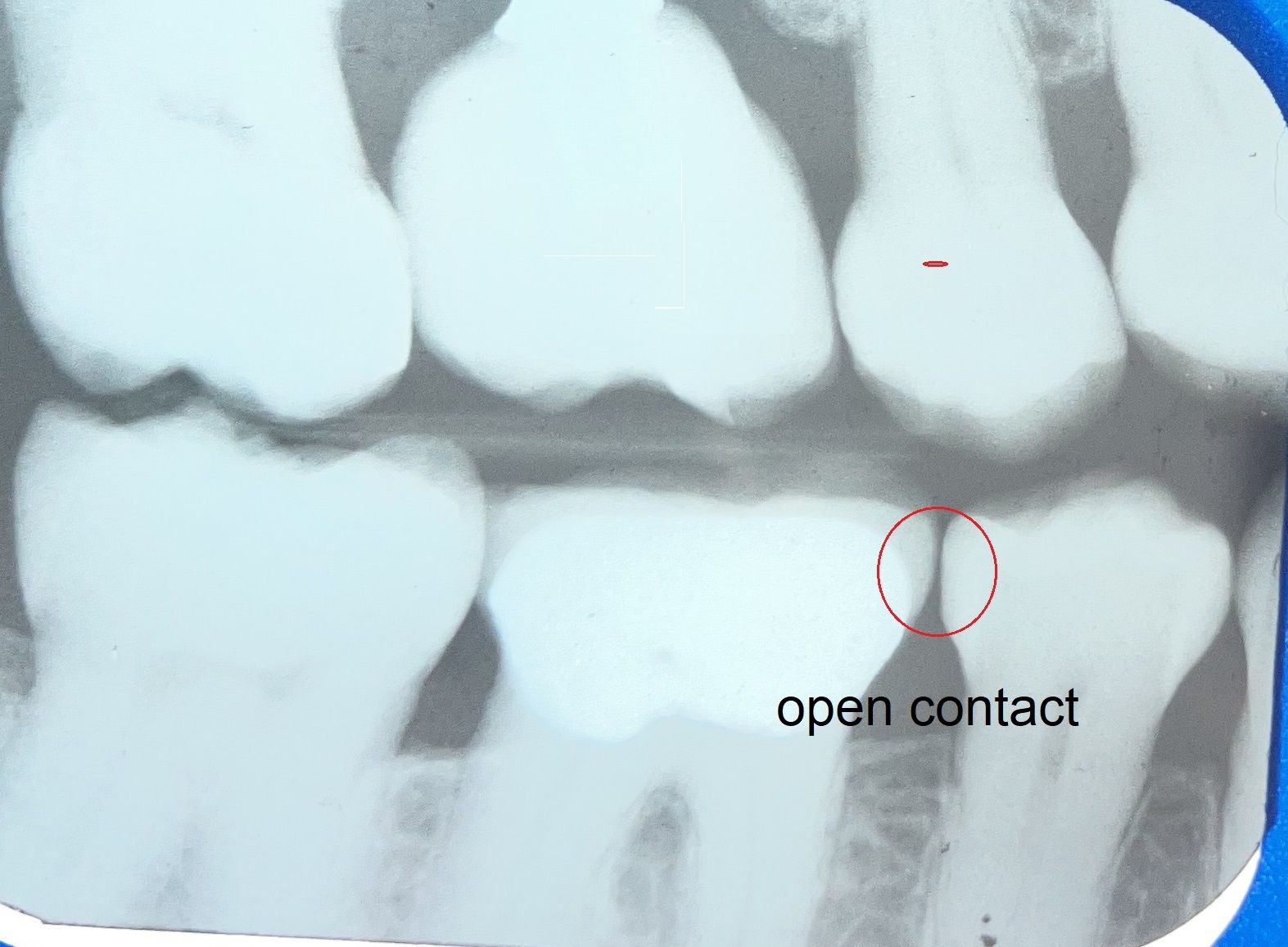
Placing a crown without proper contact points is below the standard of care. Yet it occurs more frequently than patients realize — particularly in high-volume production environments where time constraints, staffing pressures, and compressed fee schedules make it difficult to attend to the finer details of fit, margin integrity, and proper occlusion. These details require time and clinical attention that busy production-driven schedules don't always allow for. Patients are rarely aware that anything is wrong until the damage has already begun — manifesting as pain, gingivitis, and eventually bone loss.
Stage One: Pain
The first sign something is wrong is often pain — but not the kind most people associate with dental problems.
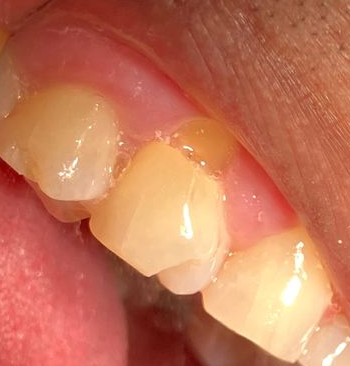
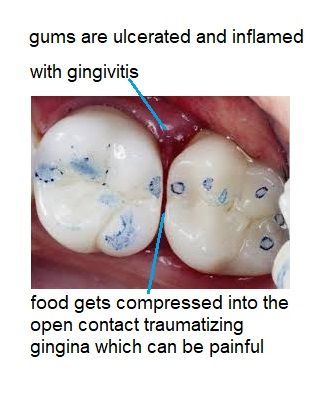
When a contact is open, food gets driven into the space between the crown and the neighboring tooth with every chewing stroke. This compacting force pushes food directly into the gum tissue below, causing trauma to the delicate gingival papilla — the small triangle of gum tissue that sits between teeth.
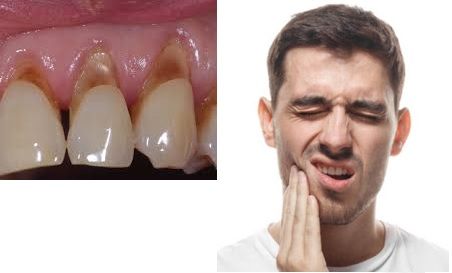
Over time this repeated trauma creates ulcers in the gum tissue that bleed and ache. Patients describe it as a sharp stabbing pain when eating, or a lingering soreness after meals.
The body is remarkably adaptive. Most patients unconsciously begin avoiding chewing on the affected side — training themselves away from using those teeth altogether. This is deeply ironic given that the tooth was crowned specifically to restore function. An avoided tooth is a failed restoration regardless of how it looks on an X-ray.
Stage Two: Gingivitis
As food continues to pack into the open contact it creates a reservoir that oral bacteria feast on.
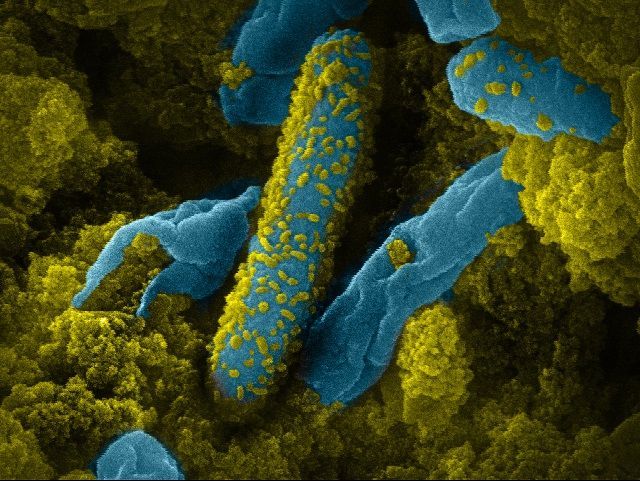
Bacteria including Streptococcus mutans and Staphylococcus aureus use the trapped food as an energy source to metabolize and multiply rapidly. Plaque colonies establish themselves in the space and begin to grow. (Socransky & Haffajee, 2002) ⁴
The gums respond to this localized bacterial infection with inflammation — this is gingivitis. (Lang & Bartold, 2018) ³ The classic signs appear:
- Red, puffy gum tissue around the crowned tooth
- Bleeding when brushing or flossing in that area
- Tenderness and sensitivity along the gumline
At this stage the damage is still reversible. (Lang & Bartold, 2018) ³ Professional cleaning and correction of the open contact can allow the gums to heal. But without intervention, gingivitis progresses to something far more serious.
Stage Three: Bone Loss (Periodontitis)
This is where the consequences become permanent.
As plaque accumulates it mineralizes into calculus — hardened deposits that cling to the root surface and push deeper and deeper below the gumline. (Socransky & Haffajee, 2002) ⁴ The bacterial colonies travel with it, establishing themselves further down the root with each passing month. (Mombelli, 2018) ⁵
Once pockets around the tooth reach 4mm or deeper the patient can no longer clean them with a toothbrush at home. (Highfield, 2009) ¹ The bacteria in these deeper pockets are now beyond reach — free to cause destruction unchecked.
What happens next is a systematic dismantling of everything that holds the tooth in place:
- Bacteria use the periodontal ligament — the fibrous tissue anchoring the tooth to bone — as a food source, breaking it down (Albandar, 2014) ⁸
- The surrounding bone begins to erode as the chronic infection triggers the body's own bone-resorbing cells called osteoclasts (Armitage, 1999) ²
- The gums begin to peel away from the tooth as the supporting structures collapse (Highfield, 2009) ¹
- The tooth begins to loosen as bone support disappears (Polson & Caton, 1982) ⁶
As the tooth loses bone support it enters what is called an unfavorable crown to root ratio — meaning more of the tooth is exposed above the bone than is anchored within it. This mechanical disadvantage accelerates the destruction. The body recognizes the now-mobile tooth as a foreign object, ramps up osteoclast activity, widens the ligament space, encapsulates the tooth, and ultimately — the tooth is lost. (American Academy of Periodontology) ⁷


How Fast Does This Happen?
The rate at which a patient progresses from discomfort to bone loss varies significantly based on three factors: (Albandar, 2014) ⁸
- Oral Hygiene — patients who brush and floss meticulously may slow the progression significantly even with an open contact present
- Chewing Habits — patients who heavily use the affected side drive more food into the contact and accelerate gingival trauma and bacterial accumulation
- Genetics — some patients have immune responses and bone densities that make them inherently more resistant or susceptible to periodontal breakdown (Albandar, 2014) ⁸
What is consistent across all patients is the direction of travel. Without correction an open contact does not get better on its own. It progresses.
What Should You Do If You Suspect an Open Contact?
If you have a crowned tooth and experience any of the following — take it seriously:
- Food consistently packing between a crowned tooth and its neighbor
- Pain or sharp discomfort when chewing in that area
- Bleeding gums specifically around a crowned tooth
- A crowned tooth you find yourself avoiding when chewing
The sooner it is addressed the more tooth and bone can be preserved. (Lang & Bartold, 2018) ³
These are not normal post-crown symptoms. They are warning signs.
We can evaluate the contact with dental floss, X-rays, and clinical probing in minutes. If an open contact is confirmed the crown may need to be replaced or in some cases a contact can be built up.

The Bigger Picture
This is one of the reasons independent dental practices matter. When a dentist is not pressured by production quotas, insurance fee schedules, or commission-based incentives — they have the time and the motivation to get the details right.
A crown with a proper contact, a proper margin, and proper occlusion takes more time and more skill. That attention to detail is the difference between a restoration that lasts decades and one that quietly destroys the tooth it was meant to protect.
📞 (813) 672-1917 📅 Same-day & Saturday appointments available 📍 6917 US Hwy 301 S, Riverview, FL 33578
References
- Highfield J. Diagnosis and classification of periodontal disease. Australian Dental Journal. 2009;54(1 Suppl):S11-S26. https://doi.org/10.1111/j.1834-7819.2009.01140.x
- Armitage GC. Development of a classification system for periodontal diseases and conditions. Annals of Periodontology. 1999;4(1):1-6. https://doi.org/10.1902/annals.1999.4.1.1
- Lang NP, Bartold PM. Periodontal health. Journal of Clinical Periodontology. 2018;45(Suppl 20):S9-S16. https://doi.org/10.1111/jcpe.12936
- Socransky SS, Haffajee AD. Dental biofilms: difficult therapeutic targets. Periodontology 2000. 2002;28:12-55. https://doi.org/10.1034/j.1600-0757.2002.280102.x
- Mombelli A. Microbial colonization of the periodontal pocket and its significance for periodontal therapy. Periodontology 2000. 2018;76(1):85-96. https://doi.org/10.1111/prd.12159
- Polson AM, Caton JG. Factors influencing periodontal repair and regeneration. Journal of Periodontology. 1982;53(10):617-625.
- American Academy of Periodontology. Periodontitis. https://www.perio.org/consumer/periodontitis
- Albandar JM. Aggressive and acute periodontal diseases. Periodontology 2000. 2014;65(1):7-12. https://doi.org/10.1111/prd.12011
This article is intended for educational purposes only and does not constitute medical advice. If you are experiencing symptoms described in this article please consult your dentist promptly.
#DentalCrowns #OpenContacts #FoodImpaction #DentalHealth #OralHealth #CrownFailure #ToothDecay #GumDisease #PreventiveDentistry #RestorativeDentistry #DentalCare #HealthySmile #DentalTreatment #CosmeticDentistry #RiverviewFL #DentistRiverview #FamilyDentistry #DentalTips #SmileCare #OralHygiene